Bias is a constant word we hear a lot of time, it seems like those sophisticated-sounding words that make you sound a lot smarter when you apply them in the right context. In simple terms, bias is a tendency to believe that certain ideas, people, ideas, etc., are better than others which usually results in treating some people unfairly.
In carrying out UX research we have to do our best to see past our opinions and judgments, but researchers are also human so it is nearly impossible to be immune to bias rather we can consciously reduce them.
In this article, we’ll be discussing a couple of these biases and how to reduce them. Before trying to the solve problem we would need to identify some of the different types of Bias user researchers face. If any of them sound like you a bit, it probably is 😉
Framing Effect
This is a really popular one in User Research, it just mean that human beings don’t make choices in isolation. We are highly dependent on the way it is presented to us.
For example, a price that is described as ‘discounted’ will attract more buyers than the same price without the ‘discounted’ label. Framing affects all aspects of UX work, from interpreting research findings to selecting design alternatives.
In a research carried out by NNgroup the method in which the same task was asked or “Framed” affected the response to whether or not that product should be redesign
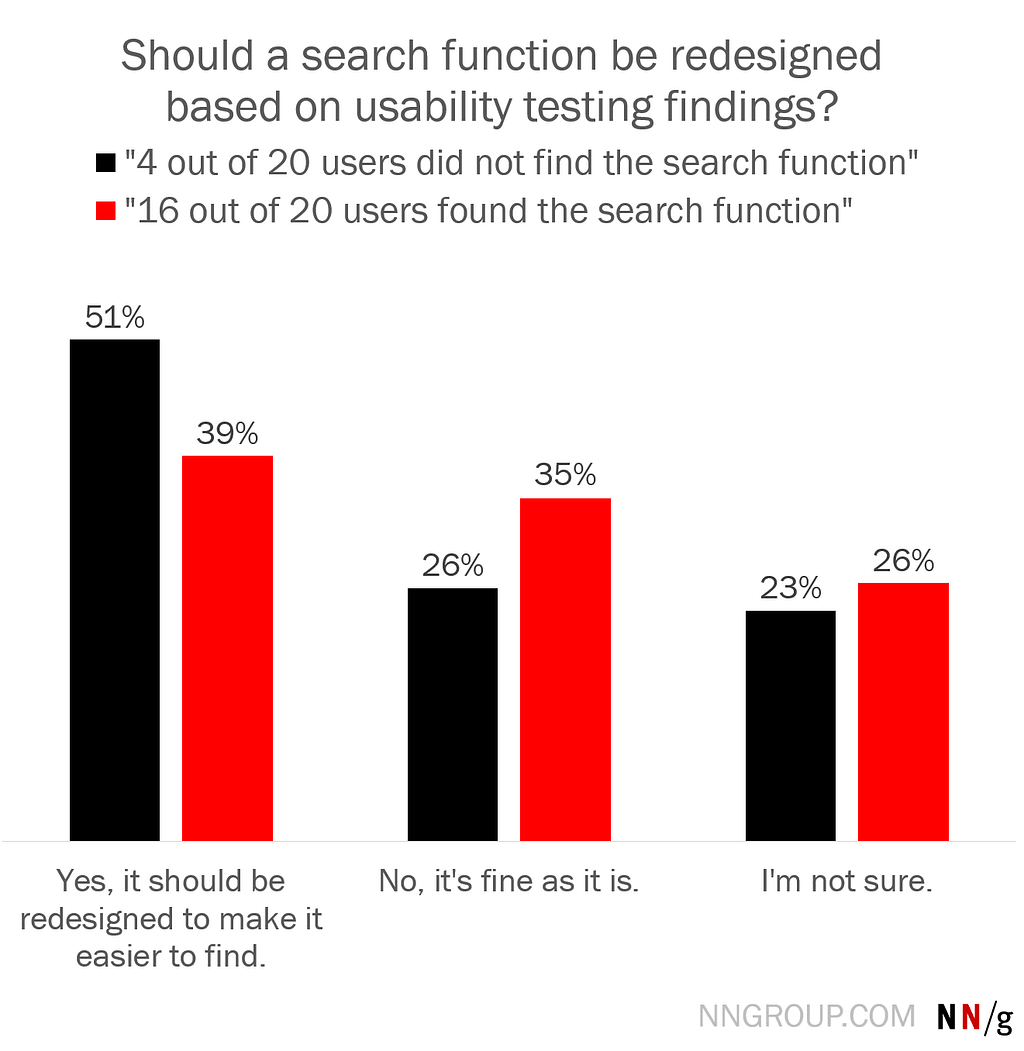
To avoid this we should ask neutral, non-indicative questions, such as “Can you describe the last time you used it?” or “How do you feel when you use this product?” would yield better-unbiased results.
Confirmation Bias
The tendency to select and favor ideas that confirm one’s own pre-existing beliefs is known as Confirmation bias. The reason this is dangerous for research is that it prevents us from being open-minded and eliminates the possibility of other viewpoints.
For example, I wanted to learn about users’ perceptions of online streaming services in a specific region, and I assumed users would find the experience poor, so I was surprised to hear users say they enjoy using it.
Recency Bias
You know that thing people do when there’s a new artist in town, blowing up the charts, and all of a sudden we feel the need to compare them to artists that have a lot more years of experience and a lot more accolades….. Yeah, that’s what this is
People tend to prioritize their most recent experiences, which might have a favorable or negative impact on your research.
When answering questions, participants usually base their conclusions on their most recent experiences than on their entire experience. In cases like this is it advisable to use a large sample size to help cancel out some of the bias
The Hawthorne Effect
Remember those times at work when you would behave differently when your boss wasn’t in? 🌚 Or when you’d act differently when your parents weren’t observing you?
This ‘Hawthorne Effect’ can happen during a research study, whereby participants change their behaviors because you are there watching them. People may act differently and watch what they say to avoid what they perceive as judgment.
To counter this, researchers should try to blend into the background as much as possible and encourage participants to act as if no one is around.
False consensus bias
False consensus bias is the assumption that people will share the same thought process as you do. In UX research, the false consensus bias happens when we overestimate the number of people who will agree with our idea or design, which creates a false consensus.
You can avoid false consensus bias by identifying and articulating your assumptions.
For example, you might live in a country and believe that citizens of that country would share certain political ideas as you cause you’ve all suffered enough at the hands of previous political parties, you would be very wrong.
Finding a few people who do align with your beliefs and assuming they represent the entire community is a false consensus. That’s another reason to survey large groups of people.
TL;DR
- Framing effect — Framing of questions can influence responses
Solution
- Be careful of how you state your questions, use a neutral, non-indicative way of questioning,
2. Confirmation Bias — Humans tend to only look for evidence confirming their hypothesis.
Solution
- Pick a large pool of participants to work with
- Do not work alone on user research, have a teammate assist you
3. Recency Bias — Individuals tend to give greater importance to recent events or information over older ones.
Solution
- Take detailed notes or recordings for each interview or conversation you have.
4. Hawthorne Effect— People may act differently and watch what they say to avoid what they perceive as judgment.
Solution
- Try to be as hidden as possible, while carrying out research
- Make participants aware that there are no right or wrong answers
5. False Consensus— Assuming that people will share the same thought process as you do
Solution
- Have other members of your team join your research
- Choose a large pool of participate
- Aim for research findings not validation of your assumptions
In Conclusion
By implementing these strategies, you can help minimize biases in user research and obtain more accurate insights to inform product development and decision-making.
Don’t forget to leave a clap 👏 you can also reach out to me on Twitter or Linkedin
Originally published on Medium ↗